 Add to Chrome
 Add to Firefox
 Add to Edge
Vision-Language-Action Safety: Threats, Challenges, Evaluations, and Mechanisms
Apr 26, 2026
Vision-Language-Action (VLA) models are emerging as a unified substrate for embodied intelligence. This shift raises a new class of safety challenges, stemming from the embodied nature of VLA systems, including irreversible physical consequences, a multimodal attack surface across vision, language, and state, real-time latency constraints on defense, error propagation over long-horizon trajectories, and vulnerabilities in the data supply chain. Yet the literature remains fragmented across robotic learning, adversarial machine learning, AI alignment, and autonomous systems safety. This survey provides a unified and up-to-date overview of safety in Vision-Language-Action models. We organize the field along two parallel timing axes, attack timing (training-time vs. inference-time and defense timing (training-time vs. inference-time, linking each class of threat to the stage at which it can be mitigated. We first define the scope of VLA safety, distinguishing it from text-only LLM safety and classical robotic safety, and review the foundations of VLA models, including architectures, training paradigms, and inference mechanisms. We then examine the literature through four lenses: Attacks, Defenses, Evaluation, and Deployment. We survey training-time threats such as data poisoning and backdoors, as well as inference-time attacks including adversarial patches, cross-modal perturbations, semantic jailbreaks, and freezing attacks. We review training-time and runtime defenses, analyze existing benchmarks and metrics, and discuss safety challenges across six deployment domains. Finally, we highlight key open problems, including certified robustness for embodied trajectories, physically realizable defenses, safety-aware training, unified runtime safety architectures, and standardized evaluation.

NoLan: Mitigating Object Hallucinations in Large Vision-Language Models via Dynamic Suppression of Language Priors
Feb 25, 2026Object hallucination is a critical issue in Large Vision-Language Models (LVLMs), where outputs include objects that do not appear in the input image. A natural question arises from this phenomenon: Which component of the LVLM pipeline primarily contributes to object hallucinations? The vision encoder to perceive visual information, or the language decoder to generate text responses? In this work, we strive to answer this question through designing a systematic experiment to analyze the roles of the vision encoder and the language decoder in hallucination generation. Our observations reveal that object hallucinations are predominantly associated with the strong priors from the language decoder. Based on this finding, we propose a simple and training-free framework, No-Language-Hallucination Decoding, NoLan, which refines the output distribution by dynamically suppressing language priors, modulated based on the output distribution difference between multimodal and text-only inputs. Experimental results demonstrate that NoLan effectively reduces object hallucinations across various LVLMs on different tasks. For instance, NoLan achieves substantial improvements on POPE, enhancing the accuracy of LLaVA-1.5 7B and Qwen-VL 7B by up to 6.45 and 7.21, respectively. The code is publicly available at: https://github.com/lingfengren/NoLan.
LightBagel: A Light-weighted, Double Fusion Framework for Unified Multimodal Understanding and Generation
Oct 27, 2025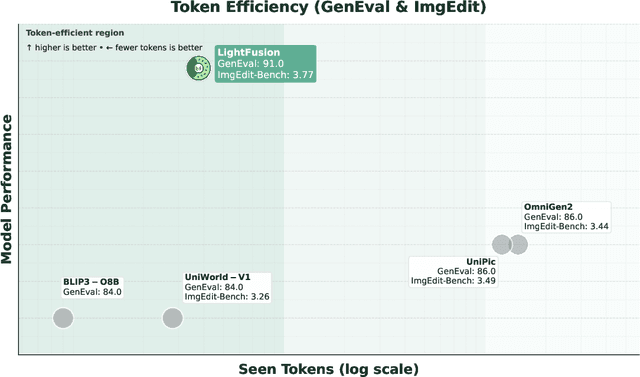
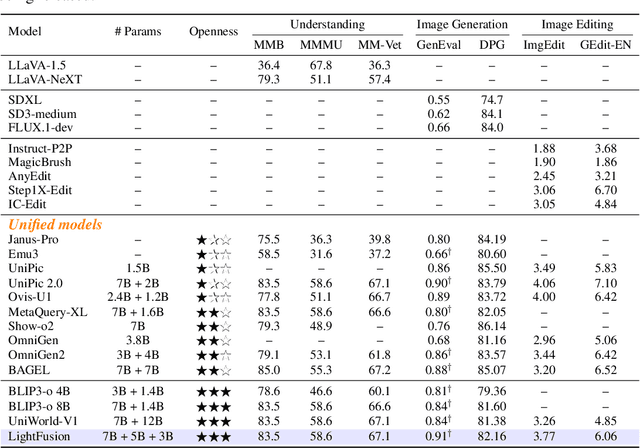
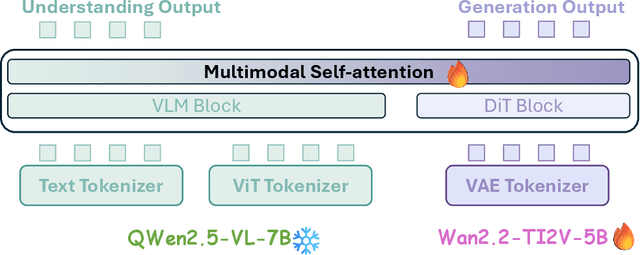
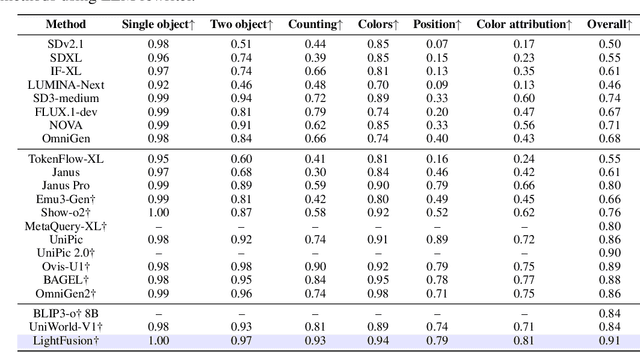
Unified multimodal models have recently shown remarkable gains in both capability and versatility, yet most leading systems are still trained from scratch and require substantial computational resources. In this paper, we show that competitive performance can be obtained far more efficiently by strategically fusing publicly available models specialized for either generation or understanding. Our key design is to retain the original blocks while additionally interleaving multimodal self-attention blocks throughout the networks. This double fusion mechanism (1) effectively enables rich multi-modal fusion while largely preserving the original strengths of the base models, and (2) catalyzes synergistic fusion of high-level semantic representations from the understanding encoder with low-level spatial signals from the generation encoder. By training with only ~ 35B tokens, this approach achieves strong results across multiple benchmarks: 0.91 on GenEval for compositional text-to-image generation, 82.16 on DPG-Bench for complex text-to-image generation, 6.06 on GEditBench, and 3.77 on ImgEdit-Bench for image editing. By fully releasing the entire suite of code, model weights, and datasets, we hope to support future research on unified multimodal modeling.
Artificial Hippocampus Networks for Efficient Long-Context Modeling
Oct 08, 2025Long-sequence modeling faces a fundamental trade-off between the efficiency of compressive fixed-size memory in RNN-like models and the fidelity of lossless growing memory in attention-based Transformers. Inspired by the Multi-Store Model in cognitive science, we introduce a memory framework of artificial neural networks. Our method maintains a sliding window of the Transformer's KV cache as lossless short-term memory, while a learnable module termed Artificial Hippocampus Network (AHN) recurrently compresses out-of-window information into a fixed-size compact long-term memory. To validate this framework, we instantiate AHNs using modern RNN-like architectures, including Mamba2, DeltaNet, and Gated DeltaNet. Extensive experiments on long-context benchmarks LV-Eval and InfiniteBench demonstrate that AHN-augmented models consistently outperform sliding window baselines and achieve performance comparable or even superior to full-attention models, while substantially reducing computational and memory requirements. For instance, augmenting the Qwen2.5-3B-Instruct with AHNs reduces inference FLOPs by 40.5% and memory cache by 74.0%, while improving its average score on LV-Eval (128k sequence length) from 4.41 to 5.88. Code is available at: https://github.com/ByteDance-Seed/AHN.
AsyMoE: Leveraging Modal Asymmetry for Enhanced Expert Specialization in Large Vision-Language Models
Sep 16, 2025Large Vision-Language Models (LVLMs) have demonstrated impressive performance on multimodal tasks through scaled architectures and extensive training. However, existing Mixture of Experts (MoE) approaches face challenges due to the asymmetry between visual and linguistic processing. Visual information is spatially complete, while language requires maintaining sequential context. As a result, MoE models struggle to balance modality-specific features and cross-modal interactions. Through systematic analysis, we observe that language experts in deeper layers progressively lose contextual grounding and rely more on parametric knowledge rather than utilizing the provided visual and linguistic information. To address this, we propose AsyMoE, a novel architecture that models this asymmetry using three specialized expert groups. We design intra-modality experts for modality-specific processing, hyperbolic inter-modality experts for hierarchical cross-modal interactions, and evidence-priority language experts to suppress parametric biases and maintain contextual grounding. Extensive experiments demonstrate that AsyMoE achieves 26.58% and 15.45% accuracy improvements over vanilla MoE and modality-specific MoE respectively, with 25.45% fewer activated parameters than dense models.
X-GRM: Large Gaussian Reconstruction Model for Sparse-view X-rays to Computed Tomography
May 21, 2025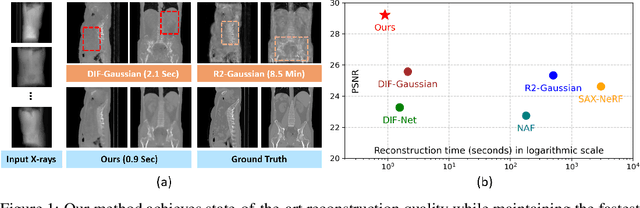
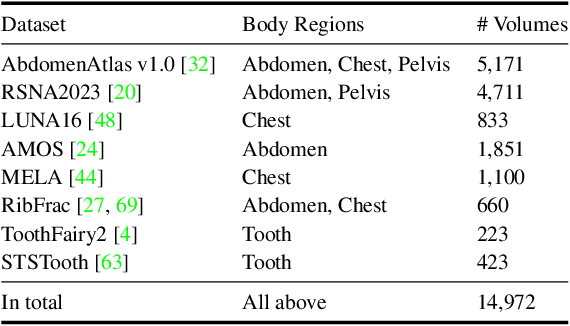
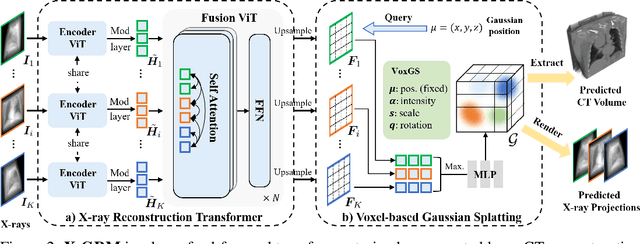
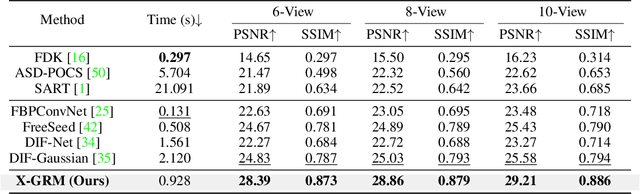
Computed Tomography serves as an indispensable tool in clinical workflows, providing non-invasive visualization of internal anatomical structures. Existing CT reconstruction works are limited to small-capacity model architecture, inflexible volume representation, and small-scale training data. In this paper, we present X-GRM (X-ray Gaussian Reconstruction Model), a large feedforward model for reconstructing 3D CT from sparse-view 2D X-ray projections. X-GRM employs a scalable transformer-based architecture to encode an arbitrary number of sparse X-ray inputs, where tokens from different views are integrated efficiently. Then, tokens are decoded into a new volume representation, named Voxel-based Gaussian Splatting (VoxGS), which enables efficient CT volume extraction and differentiable X-ray rendering. To support the training of X-GRM, we collect ReconX-15K, a large-scale CT reconstruction dataset containing around 15,000 CT/X-ray pairs across diverse organs, including the chest, abdomen, pelvis, and tooth etc. This combination of a high-capacity model, flexible volume representation, and large-scale training data empowers our model to produce high-quality reconstructions from various testing inputs, including in-domain and out-domain X-ray projections. Project Page: https://github.com/CUHK-AIM-Group/X-GRM.
MonoSplat: Generalizable 3D Gaussian Splatting from Monocular Depth Foundation Models
May 21, 2025Recent advances in generalizable 3D Gaussian Splatting have demonstrated promising results in real-time high-fidelity rendering without per-scene optimization, yet existing approaches still struggle to handle unfamiliar visual content during inference on novel scenes due to limited generalizability. To address this challenge, we introduce MonoSplat, a novel framework that leverages rich visual priors from pre-trained monocular depth foundation models for robust Gaussian reconstruction. Our approach consists of two key components: a Mono-Multi Feature Adapter that transforms monocular features into multi-view representations, coupled with an Integrated Gaussian Prediction module that effectively fuses both feature types for precise Gaussian generation. Through the Adapter's lightweight attention mechanism, features are seamlessly aligned and aggregated across views while preserving valuable monocular priors, enabling the Prediction module to generate Gaussian primitives with accurate geometry and appearance. Through extensive experiments on diverse real-world datasets, we convincingly demonstrate that MonoSplat achieves superior reconstruction quality and generalization capability compared to existing methods while maintaining computational efficiency with minimal trainable parameters. Codes are available at https://github.com/CUHK-AIM-Group/MonoSplat.
Emerging Properties in Unified Multimodal Pretraining
May 20, 2025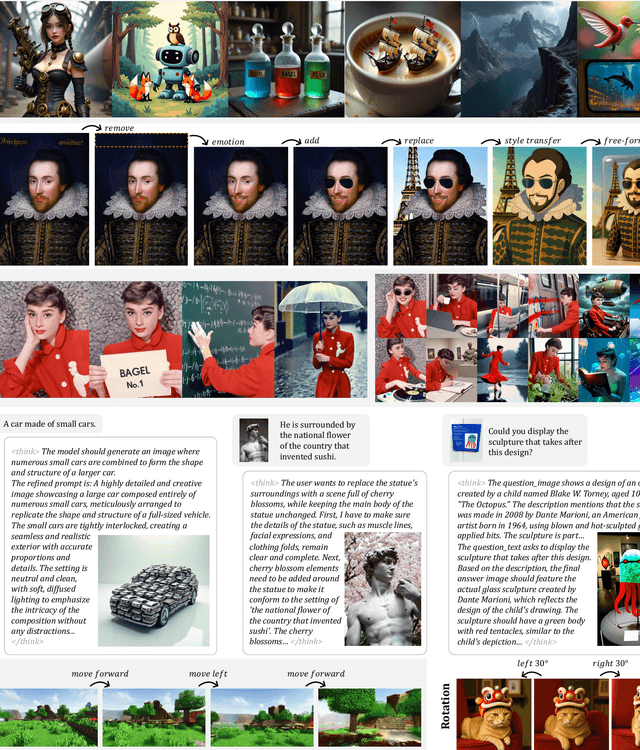
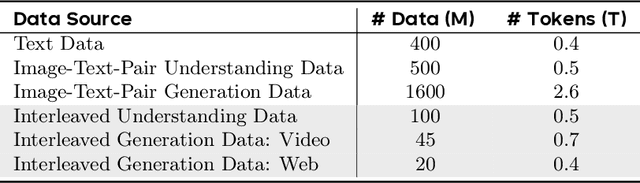
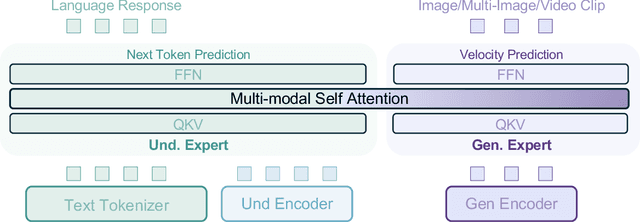
Unifying multimodal understanding and generation has shown impressive capabilities in cutting-edge proprietary systems. In this work, we introduce BAGEL, an open0source foundational model that natively supports multimodal understanding and generation. BAGEL is a unified, decoder0only model pretrained on trillions of tokens curated from large0scale interleaved text, image, video, and web data. When scaled with such diverse multimodal interleaved data, BAGEL exhibits emerging capabilities in complex multimodal reasoning. As a result, it significantly outperforms open-source unified models in both multimodal generation and understanding across standard benchmarks, while exhibiting advanced multimodal reasoning abilities such as free-form image manipulation, future frame prediction, 3D manipulation, and world navigation. In the hope of facilitating further opportunities for multimodal research, we share the key findings, pretraining details, data creation protocal, and release our code and checkpoints to the community. The project page is at https://bagel-ai.org/
Top-Down Compression: Revisit Efficient Vision Token Projection for Visual Instruction Tuning
May 17, 2025Visual instruction tuning aims to enable large language models to comprehend the visual world, with a pivotal challenge lying in establishing an effective vision-to-language projection. However, existing methods often grapple with the intractable trade-off between accuracy and efficiency. In this paper, we present LLaVA-Meteor, a novel approach designed to break this deadlock, equipped with a novel Top-Down Compression paradigm that strategically compresses visual tokens without compromising core information. Specifically, we construct a trainable Flash Global Fusion module based on efficient selective state space operators, which aligns the feature space while enabling each token to perceive holistic visual context and instruction preference at low cost. Furthermore, a local-to-single scanning manner is employed to effectively capture local dependencies, thereby enhancing the model's capability in vision modeling. To alleviate computational overhead, we explore a Visual-Native Selection mechanism that independently assesses token significance by both the visual and native experts, followed by aggregation to retain the most critical subset. Extensive experiments show that our approach reduces visual tokens by 75--95% while achieving comparable or superior performance across 12 benchmarks, significantly improving efficiency.
Seed1.5-VL Technical Report
May 11, 2025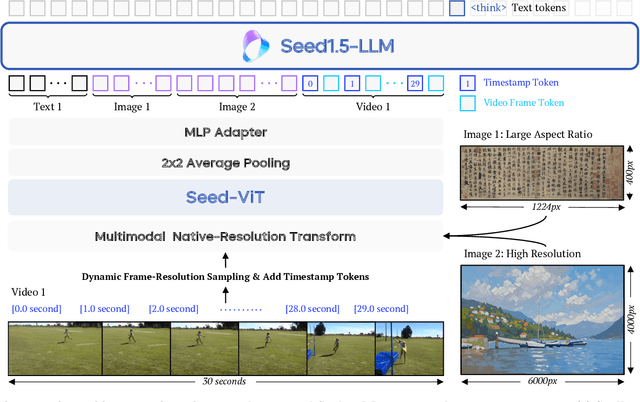

We present Seed1.5-VL, a vision-language foundation model designed to advance general-purpose multimodal understanding and reasoning. Seed1.5-VL is composed with a 532M-parameter vision encoder and a Mixture-of-Experts (MoE) LLM of 20B active parameters. Despite its relatively compact architecture, it delivers strong performance across a wide spectrum of public VLM benchmarks and internal evaluation suites, achieving the state-of-the-art performance on 38 out of 60 public benchmarks. Moreover, in agent-centric tasks such as GUI control and gameplay, Seed1.5-VL outperforms leading multimodal systems, including OpenAI CUA and Claude 3.7. Beyond visual and video understanding, it also demonstrates strong reasoning abilities, making it particularly effective for multimodal reasoning challenges such as visual puzzles. We believe these capabilities will empower broader applications across diverse tasks. In this report, we mainly provide a comprehensive review of our experiences in building Seed1.5-VL across model design, data construction, and training at various stages, hoping that this report can inspire further research. Seed1.5-VL is now accessible at https://www.volcengine.com/ (Volcano Engine Model ID: doubao-1-5-thinking-vision-pro-250428)